

Hey there!
You do not need to fear AI to raise a strong child. You need a calm, clear way to lead your child through it.
Many parents feel pressure right now. Screens are always close. AI can answer questions, write text, and keep children occupied fast. You may worry about focus, honesty, screen habits, and how to keep your child grounded.
A lot of parents respond by trying to control every behavior. They add more rules, more warnings, or more rewards. That often does not work for long because it deals with the moment, not the skill behind the moment.
A Better Way To Parent Through Change
The better approach is not harsh control and it is not giving in. It is steady leadership.
Your child needs you to stay close, hold clear limits, and help them handle hard feelings. That is what helps children grow strong on the inside.
If you only react to behavior, you miss the real issue. A child who lies, melts down, or shuts down is often dealing with stress, shame, overload, or a skill that is not built yet.
Dr. Becky Kennedy’s core idea is helpful here: your child is good inside. Your job is to lead with care and limits at the same time.
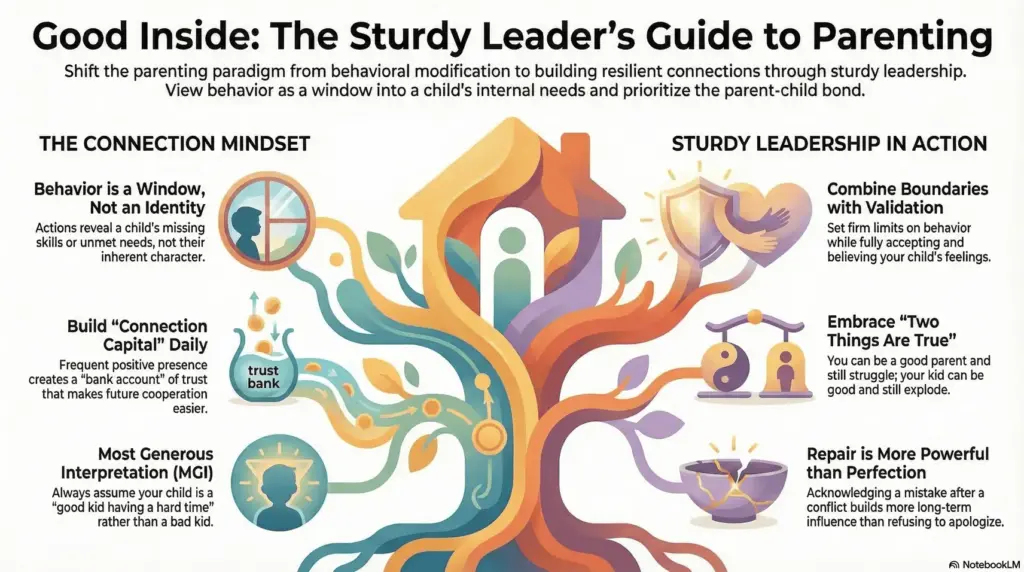
This works because children build self-control, honesty, and trust in small daily moments.
Now let’s go step by step.
Let’s dive in!
Step 1: See Behavior As A Signal, Not A Character Flaw
This step matters because the way you read your child’s behavior shapes what you do next.
When you treat behavior as a signal, you stop asking, “How do I shut this down fast?” You start asking, “What is going on here, and what does my child need to learn?”
Here are three common situations:
- Your child explodes when screen time ends.
- Your child uses AI to finish homework and hides it.
- Your child gets rude or shuts down after making a mistake.
These situations may look like bad behavior, but they are not all the same. The first may be about trouble stopping and shifting gears. The second may be about fear, shame, or pressure. The third may be about low frustration tolerance or a harsh inner voice.
That difference matters. If you treat every problem like defiance, you miss the chance to teach the right skill. One child may need help with transitions. Another may need help telling the truth. Another may need help calming down after disappointment.
If you skip this step, home can start to feel tense very fast. Your child learns to hide, argue, or shut down. You may become more reactive. Over time, your child may get better at avoiding trouble, but not better at handling feelings, limits, or responsibility.
Step 2: Be Kind And Firm At The Same Time
This step changes a lot because your child needs warmth and structure together.
You do not have to choose between empathy and limits. You can be caring and still hold the line.
This is what sturdy leadership looks like. You stay calm. You name the limit clearly. You help your child through the upset without removing the limit.
Do not skip this and jump to threats, lectures, or endless bargaining.
Here are two things to do:
- Say the limit in plain words: “Screen time is over. I know that is hard.”
- Say what you will do next: “I’m putting the tablet away now. You can be upset, and I will help you through it.”
This works because your child needs to feel that you can handle the moment. That matters even more now, because many apps, games, and AI tools are made to keep children engaged for a long time. Your child will not build self-control from tech alone. Your child builds it with your support, your limits, and your consistency.

Step 3: Help With Feelings Before You Teach The Lesson
This step helps because children cannot learn much when they are flooded with emotion.
Do not rush into correction too soon. If your child feels ashamed, angry, or overwhelmed, a lesson will usually bounce off.
Ask yourself these six questions:
- What is my child feeling right now?
- What may have set this off?
- Is this defiance, stress, shame, or overload?
- What skill is missing here?
- What is getting stirred up in me?
- What limit still needs to stay in place?
This quick pause helps you respond better. It also helps you notice your own triggers. Sometimes a child ignoring homework, lying, or talking back hits something old in you. It may touch your fear of failure, disrespect, or losing control. If you do not notice that, you may react from your own stress instead of leading the moment.
Once you slow down, your words get better. You might say, “You wanted an easy way out. I get that. But we still need to do this honestly.” Or, “You are really upset right now. I’m here, and the limit still stands.”
This small pause makes the next part much easier. You stop trying to win the moment. You start trying to teach the skill.
Step 4: Repair After Hard Moments
By now, you have changed how you see behavior, held the limit, and slowed yourself down.
That makes this step easier. Repair is not about being perfect. It is about making things right after a hard moment.
Your child does not need a perfect parent. Your child needs a parent who can come back, take responsibility, and reconnect.
The work you did in the first steps helps here. When you stop seeing mistakes as failure, repair feels normal. It becomes part of how your family grows.
A real repair can sound like this: “I yelled earlier, and that was not okay. I’m sorry. The homework still matters, but I want to handle it better with you.”
That kind of repair teaches a lot. It shows your child that mistakes can be faced. It shows that limits and closeness can exist together. It shows that conflict does not have to break the relationship.
If you never repair, your child may remember the correction but miss the safety. If you do repair, your child learns trust, accountability, and how to come back after a hard moment.
Step 5: Build Daily Habits That Protect Your Child In A Digital World
This is where all the earlier steps start to show in daily life.
You are not only reacting to problems anymore. You are building habits that help your child use screens and AI without leaning on them for every answer, every feeling, or every quiet moment.
Do these simple things:
- Keep devices out of bedrooms at night.
- Use school tech in shared spaces when possible.
- Talk about AI as a tool, not a shortcut.
- Ask your child to explain school answers in their own words.
- Protect time for boredom, outdoor play, reading, and face-to-face talk.
- Pause screens first when emotions are running high.
These habits matter because children need practice being bored, solving problems, waiting, and thinking for themselves. They also need help learning honesty. AI can support learning, but it should not replace effort.
If your child uses AI for schoolwork, stay calm and be direct. You can say, “I’m not upset that you used a tool. I’m concerned that you skipped the learning. Let’s fix that.” This keeps the focus on growth and responsibility.
You also need to model what you want. If you want your child to put the phone down, let them see you do the same. If you want thoughtful tech use, show it in your own habits too.
This is how resilience grows in the AI age. Your child learns how to handle limits, tell the truth, calm down, recover after mistakes, and use technology without depending on it too much.
You just learned a 5-step way to parent with more steadiness in a fast-changing time.
You learned to see behavior as a signal, stay kind and firm, help with feelings before teaching, repair after hard moments, and build simple digital habits that support honesty and emotional strength.
AI will keep changing. New tools will keep coming. Your child does not need fear. Your child needs your guidance, your limits, and your steady presence.
That is what helps children grow strong, capable, and emotionally healthy.