By the end of this article, you will know exactly why Montessori education produces stronger, longer-lasting results.
Parents ask this question every day.
Is Montessori really better for my child?
It is a fair question. Choosing a school is one of the most important decisions a family makes.
The answer is already backed by research.
The evidence is strong. And it keeps getting stronger.
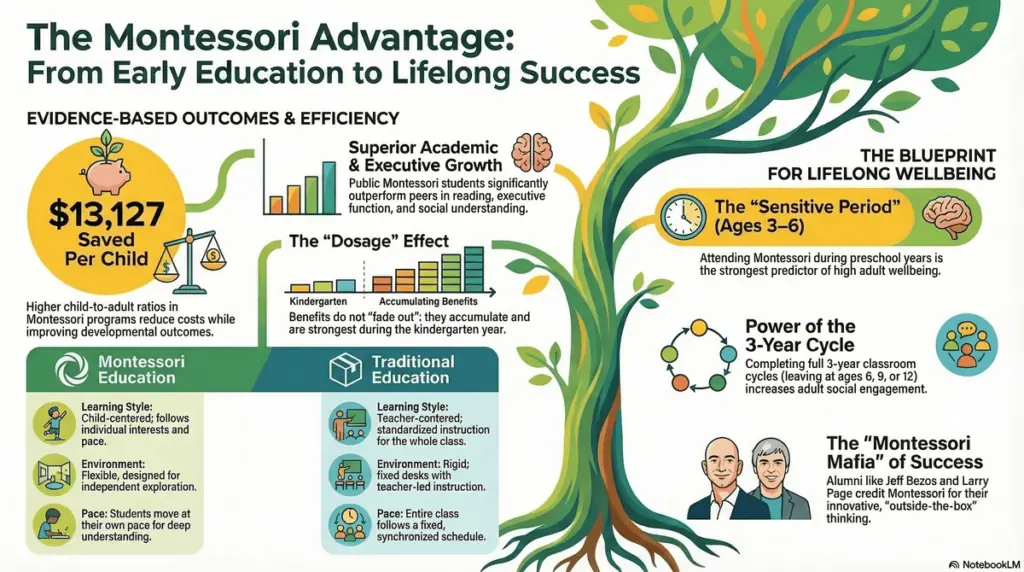
A landmark study published in late 2025 followed hundreds of children across public Montessori programmes nationwide. Montessori students outperformed peers in reading, memory, executive function, and social skills. The programmes also cost significantly less than traditional preschool.
That finding comes from a study of hundreds of children across multiple states — and the gains held through kindergarten.
This article is written for parents who want real answers — not sales pitches.
You will leave here informed.
Let’s start with the basics.
The Simple Idea That Changed How We Think About Learning
Montessori Education: Key Facts at a Glance
What exactly is Montessori education?
And why do so many families swear by it?
The idea is simple.
Children learn best when they are active participants. Not passive listeners sitting in rows.
A Montessori classroom looks completely different. Children choose their own activities. They work at their own pace. Teachers observe, guide, and support.
That is it.
The approach develops the whole child. Intellectually, socially, emotionally, and physically. It builds confidence, independence, and curiosity.
5 core principles guide every Montessori classroom:
- Respect for the child — children are trusted as natural learners
- The prepared environment — spaces designed to support exploration
- Hands-on learning materials — tactile tools that let children discover on their own
- Child-directed work — children choose their focus
- Individualized learning — lessons tailored to each child’s pace and needs
3 things people often get wrong about Montessori
First, many think Montessori classrooms are chaotic. They are not. Structure comes from the environment itself.
Second, many assume Montessori is only for young children. In fact, it spans infancy through adolescence.
Third, some believe Montessori skips academics. The evidence says otherwise. Montessori students consistently perform at or above grade level.
One more thing worth knowing.
The word “Montessori” is not trademarked. Any school can use the name. Quality varies. Look for trained, accredited educators and a clearly structured programme.
Montessori is not a trend.
It is a proven, research-backed philosophy — and the science behind it has never been stronger.
What Actually Happens Inside a Montessori Classroom
What does a Montessori classroom actually look like?
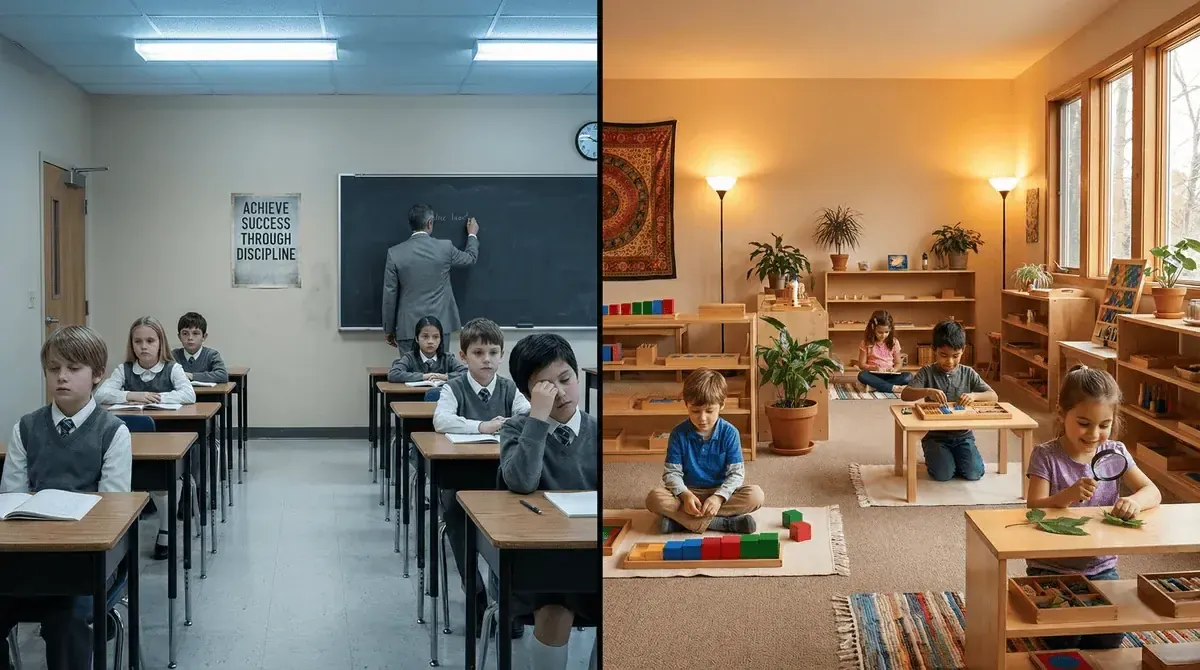
Walk into a traditional classroom. Rows of desks. A teacher at the front. Every child doing the same thing at the same time.
Now walk into a Montessori classroom.
It looks completely different.
Children move freely. Some work alone. Others work in small groups. One child sorts coloured beads. Another traces letters in a sand tray. A third helps a younger classmate with a puzzle.
It looks relaxed. But it is anything but unstructured.
The Prepared Environment
Every detail is intentional.
The room divides into learning areas — practical life, language, mathematics, sensorial exploration, and cultural studies. Materials sit at child height. Every material teaches one concept at a time. Every material corrects itself — no teacher needed to say you got it wrong.
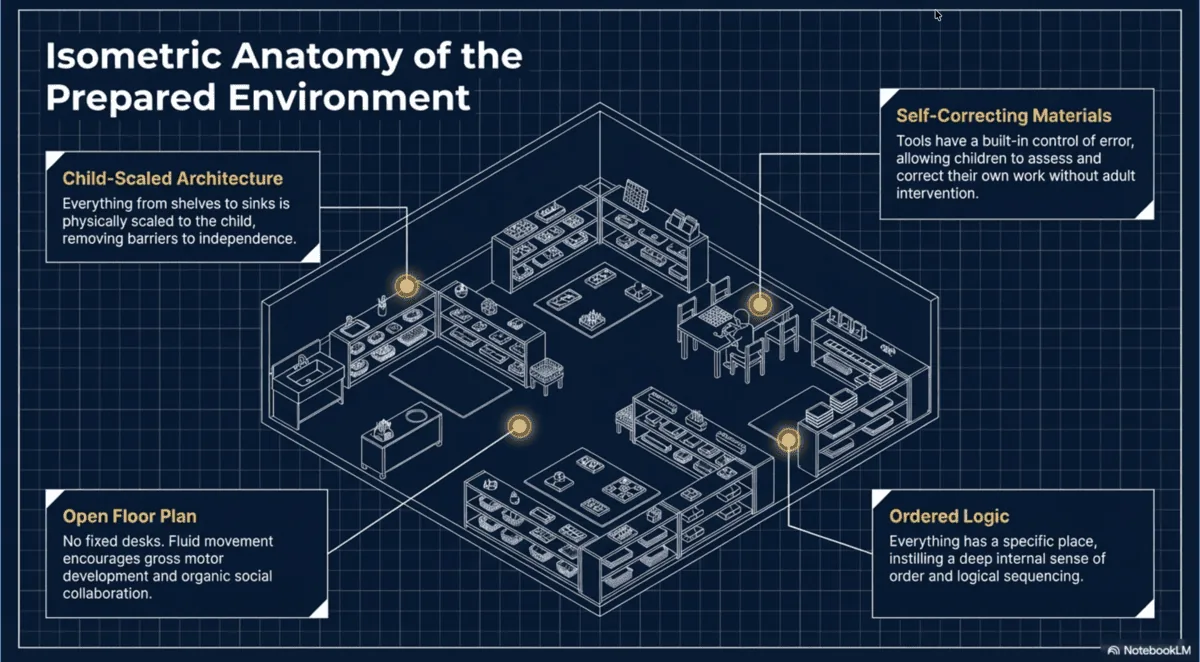
Children find their own mistakes. They fix them. They move on.
That builds problem-solving skills. That builds confidence.
The Uninterrupted Work Period
No bells. No sudden transitions.
Children choose their work. They go deep. They finish at their own pace. Typically two to three hours of continuous, self-directed learning every day.
Research confirms this works.
Montessori students do not just start strong. Their gains grow over time. That is the opposite of what most preschool research finds.
Mixed-Age Classrooms
Children group in three-year age spans.
Older children mentor younger ones. Younger children learn by watching. Leadership, empathy, and communication skills develop naturally — without a single dedicated lesson.
Research found children in mixed-age Montessori classrooms show stronger language development and more positive peer interactions.
The Teacher as Guide
The teacher does not stand at the front.
Critically, they observe. They identify where each child is developmentally. They introduce new materials one-on-one. Then they step back.
The environment does much of the teaching.
The result is a classroom where children learn because they want to. Not because they have to.
That distinction makes all the difference.
Inside a Montessori Classroom: 5 Core Learning Areas
What the Research Found — and Why It Surprised Everyone
Does the way a child learns in preschool really matter?
The research says yes.
And the evidence from Montessori is some of the most compelling in early childhood education.
Stronger Academic Results — That Actually Last
Most early childhood programmes produce short-term gains. Then those gains fade.
Researchers call this the “fade-out” problem.
By contrast, Montessori does something different.
A landmark study published in late 2025 tracked hundreds of children across public Montessori programmes nationwide. By the end of kindergarten, Montessori students outperformed peers in reading, short-term memory, executive function, and social understanding.
These gains did not fade.
They grew stronger.
Montessori is not just giving children a head start. It is building a foundation that holds.
Skills That Go Beyond Academics
Academic performance is only part of the picture.
Montessori students also develop stronger non-academic skills. The kind that matter in real life.
A large meta-analysis found Montessori students scored significantly higher than traditional school students in creativity, self-control, social skills, and mastery orientation.
These are the skills employers and communities value most.
Built in from day one.
Who Benefits Most
Research indicates most children benefit from Montessori.
But the research found that gains were strongest among children from lower-income families.
In practice, Montessori delivers its greatest impact to the children who need it most.
Long-Term Wellbeing Into Adulthood
The benefits do not stop at kindergarten.
Research published in 2025 found that adults who attended Montessori as children reported higher general wellbeing and greater engagement in life.
How children learn shapes how they live.
Montessori builds curiosity, independence, self-regulation, and empathy. Habits of mind that stay with a person for life.
What Is Changing Today
As of early 2026, Montessori schools are going deeper.
More mindfulness. More empathy-building. More conflict resolution — built into daily classroom life.
Schools are also using real-time data tools to track each child’s progress. Helping teachers respond faster to individual needs.
Montessori has always been child-centric.
Today it is more responsive than ever.
What the Research Shows: Montessori Outcomes at a Glance
Not All Montessori Schools Are Equal — Here Is What to Know
Not every Montessori school delivers the same results.
So what separates a truly effective programme from one that just uses the name?
Several key factors shape how well Montessori works.
1. Teacher Quality — The Single Biggest Factor
Teacher quality is the most important variable. In any school. In any setting.
And Montessori is no exception.
Research found that improving teacher quality produces two to three times more impact on student outcomes than reducing class size.
In a Montessori classroom, a well-trained guide does far more than manage behaviour. They observe each child. They introduce materials at exactly the right moment. They know when to step in — and when to step back.
Look for educators with accredited Montessori credentials. From the Association Montessori Internationale (AMI) or the American Montessori Society (AMS).
2. Programme Fidelity — How Closely the School Follows the Method
The word “Montessori” is not trademarked.
Any school can use it.
Look beyond the label. Look for the real thing. Uninterrupted work periods. Mixed-age classrooms. Child-directed learning. Hands-on self-correcting materials.
The more closely a programme follows these principles, the stronger the outcomes.
3. Assessment Practices — Watching, Not Testing
Genuine Montessori does not use standardised tests or letter grades.
Instead, children are assessed through ongoing observation, work sample reviews, and detailed record keeping.
Research found this approach roughly doubles typical year-over-year academic growth. With the greatest benefits among children with special needs and those from underserved communities.
4. Class Size and Structure
Here is something that surprises most people.
In Montessori classrooms, larger class sizes actually correlate with higher quality scores — the opposite of what traditional education research shows. This finding comes from the 2025 national U.S. study published in the Proceedings of the National Academy of Sciences.
But context matters here.
This only holds true when three conditions are in place: mixed-age groupings, trained Montessori-credentialed guides, and a fully prepared environment. When those conditions exist, children learn from each other naturally. Older students mentor younger ones.
The environment manages much of the learning. Remove any one of those conditions and the dynamic changes entirely.
5. How Long a Child Attends
Duration matters.
Children who spend more years in Montessori gain more. Adults who attended for many years report the highest levels of wellbeing and life engagement.
A single year is beneficial.
The full effect builds over time.
6. Accreditation and Institutional Support
Accredited schools meet specific standards. Classroom design. Teacher credentials. Materials. Programme structure.
In public school settings, collaboration between Montessori programmes and district administration strengthens outcomes further.
FAQs: The Questions Every Parent Asks — Answered Honestly
You have questions.
That is a good sign.
It means you are thinking carefully about your child’s education — and that is exactly the right instinct.
Here are the questions we hear most often.
Is Montessori right for every child?
Montessori works well for most children.
But it suits curious, independent learners particularly well. Children who enjoy hands-on exploration and working at their own pace tend to thrive.
In practice, Montessori meets each child where they are. It supports a wide range of learning styles — including children who need more structure or additional support.
How do Montessori schools measure progress without grades or tests?
Montessori minimises standardised testing and relies primarily on observation and work samples.
Instead of letter grades, teachers assess children through ongoing observation, work sample reviews, and detailed record keeping.
Will my child fall behind in academics?
No.
The opposite is more likely.
Evidence indicates Montessori students outperformed peers in reading, memory, and executive function by the end of kindergarten. A large meta-analysis found Montessori students tend to perform better academically than traditional school students — though outcomes vary depending on programme quality and implementation.
Can my child transition from Montessori to a traditional school?
Yes.
And most Montessori graduates transition well.
The independence, critical thinking, and social skills they develop give them a real advantage in new environments. The smoothest transitions happen at natural break points in the three-year cycle.
How does discipline work in a Montessori classroom?
Montessori minimises external rewards and punishments.
By contrast, children are guided to develop self-discipline through meaningful, engaging work.
Evidence indicates that when children are absorbed in purposeful activity, disruptive behaviour tends to decrease naturally.
Teachers guide children towards constructive choices. Not compliance.
How does the mixed-age classroom actually work?
Children group in three-year age spans.
Older children mentor younger ones — reinforcing their own learning in the process. Younger children learn by watching peers just ahead of them developmentally.
By contrast, children experience collaboration, leadership, and empathy every single day.
Can I use Montessori principles at home?
Yes. Easily.
Set up a low shelf with a few rotating activities. Give your child real tasks — pouring water, folding clothes, watering plants. Follow their lead when they show interest in something.
Step back. Let them try.
Are all Montessori schools the same quality?
No.
Because “Montessori” is not trademarked, any school can use the name. Quality varies widely.
Look beyond the label. Seek accredited credentials from AMI or AMS. Visit the classroom. Ask specific questions about daily structure, teacher training, and how progress is tracked.
How to Use What You Now Know — Starting Today
Understanding Montessori is one thing.
Knowing what to do with that understanding is another.
Start here.
Step 1: Know What a Genuine Montessori School Looks Like
You cannot rely on the name alone.
Walk into the classroom. Does it feel calm and purposeful? Are shelves neatly arranged with real Montessori materials? Are children moving freely and genuinely absorbed?
In practice, you should see children choosing their own work. Teachers observing quietly. A room that does much of the teaching itself.
If you see mostly toys or digital screens, keep looking.
Step 2: Ask the Right Questions
Do not be shy.
Ask direct questions during your visit:
- Are your teachers credentialed by AMI or AMS?
- How long is the uninterrupted work period each day?
- How do you track each child’s development?
- How does your school handle discipline?
- What does a typical day look like?
The answers will tell you everything.
Step 3: Think About Fit
Does your child enjoy exploring independently?
Do they stay focused when given a choice? Are they curious and self-motivated?
Montessori suits most children. Reflect on your child’s temperament first.
Also consider commitment. The benefits of Montessori grow with time. A child who attends for several years gains significantly more than one who attends for a single year.
Step 4: Bring Montessori Principles Home
You do not need a classroom.
Set up a low shelf with a few rotating activities. Give your child real, purposeful tasks — pouring water, folding clothes, watering plants, setting the table.
These are not just chores.
They build concentration, coordination, and confidence.
When your child struggles, observe before you intervene. Let them try. Let them work through it.
Critically, stepping back is one of the most powerful things a parent can do.
Step 5: Avoid These Common Mistakes
- Doing tasks for your child instead of letting them practise
- Rushing routines instead of allowing time for independence
- Cluttering the space with too many toys and choices
- Over-directing instead of modelling quietly
- Reacting with frustration instead of staying calm
These are habits.
Just notice them. Habits change with awareness.
Useful Resources to Go Further
- American Montessori Society
- Association Montessori Internationale
- Montessori Public Policy Initiative
- Guidepost Montessori Blog
Even one Montessori principle applied at home can meaningfully support your child’s growth.
Start small. Start today.
Montessori School Visit Checklist
Bring this checklist when you visit. Look for as many of these as possible.
- ☐ Classroom feels calm and purposeful — not chaotic or overly rigid
- ☐ Real Montessori materials visible on neatly arranged shelves
- ☐ Children moving freely and appearing genuinely absorbed in work
- ☐ Teachers observing and guiding — not lecturing at the front
- ☐ Mixed-age groupings in three-year spans
- ☐ Teachers hold AMI or AMS accredited credentials
- ☐ Uninterrupted work period of two to three hours daily
- ☐ Clear, observation-based approach to assessing child progress
- ☐ Discipline approach is calm, respectful, and non-punitive
- ☐ School holds recognised Montessori accreditation
Montessori, Waldorf, Reggio Emilia — What Is the Difference?
Montessori is not a single programme.
It is not just for preschool.
And it is not the only child-centred approach out there.
Here is what you actually need to know.
Montessori by Age and Stage
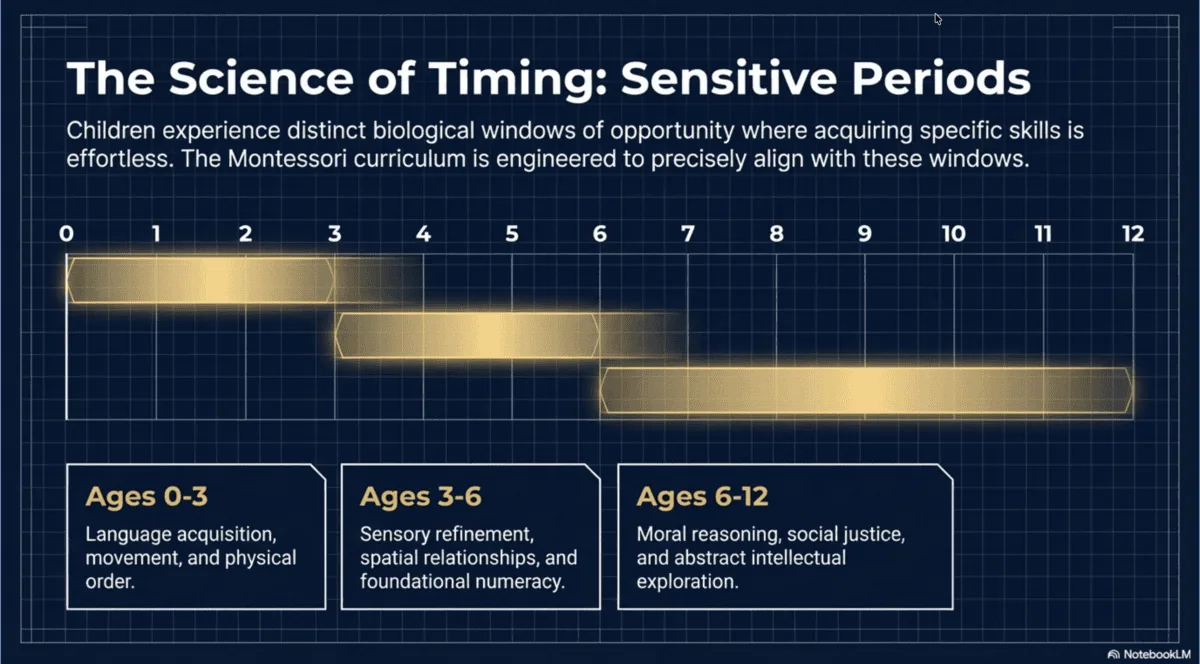
Dr. Montessori organised the approach around distinct periods of growth.
Each stage has its own priorities. Its own classroom design. Its own way of meeting the child.
- Infant (birth to 18 months) — Calm, sensory-rich. Supports movement, language, and early independence.
- Toddler (15 months to 3 years) — Practical life activities. Freedom of movement within safe boundaries.
- Early Childhood / Primary (ages 2.5 to 6) — The most widely known stage. Foundational literacy, numeracy, and social skills through hands-on, self-directed work.
- Lower Elementary (ages 6 to 9) — Bigger ideas. History, science, mathematics, and culture through storytelling and collaborative projects.
- Upper Elementary (ages 9 to 12) — Deeper enquiry. Leadership development. Children take greater ownership of their learning.
- Secondary (ages 12 to 18) — Real-world experience. Internships. Self-designed projects. Community contribution.
Each stage builds on the last.
By contrast, children deepen their relationship with learning at every level.
That is why duration matters so much.
How Montessori Compares to Similar Approaches
Parents often encounter three names together.
Montessori. Waldorf. Reggio Emilia.
All three respect the child as a capable, motivated learner. All three prioritise hands-on experience over worksheets and tests.
Here is where they differ.
Montessori centres on independence, order, and structured self-directed work. Literacy and numeracy begin early — around age three. The environment is calm and orderly. Materials are reality-based throughout.
Waldorf delays formal academics until age seven. Imagination, rhythm, storytelling, and the arts come first. The same teacher stays with a class for multiple years. Technology is minimised or avoided entirely.
Reggio Emilia is collaborative and project-based. Children and teachers build knowledge together. Learning emerges from children’s own questions and interests. There is no fixed curriculum.
Traditional schooling relies on teacher-delivered instruction. Age-based grouping. Standardised testing. A fixed curriculum delivered at the same pace for everyone.
Which Approach Is Right for Your Child?
There is no single right answer.
Think about your child first.
Does your child thrive with structure and hands-on independent work? Montessori is a strong fit.
Is your child deeply imaginative and artistic? Waldorf may resonate.
Does your child love collaborative exploration and open-ended enquiry? Reggio Emilia is worth exploring.
Many families find Montessori strikes the best balance.
Structured enough to build strong academic foundations. Flexible enough to honor each child’s pace. Research-backed enough to give parents real confidence.
That combination is hard to find anywhere else.
Montessori vs. Other Approaches: At a Glance
| Aspect | Montessori | Waldorf | Reggio Emilia | Traditional |
|---|---|---|---|---|
| Learning Structure | Child-led with prepared materials | Teacher-guided within rhythmic structure | Collaborative, project-based | Teacher-delivered instruction |
| Academics Timing | Introduced early, from age 3 | Delayed until age 7 | Emergent through enquiry | Fixed by age and grade |
| Materials | Specific, self-correcting, sequenced | Open-ended, natural materials | Fluid, shaped by projects | Textbooks and worksheets |
| Environment | Orderly, calm, prepared | Warm, natural, artistic | Aesthetic, flexible, responsive | Structured, desk-based |
| Assessment | Observation and work samples | Narrative reports | Documentation of learning | Tests and grades |
| Teacher Role | Observer and guide | Storyteller and mentor | Co-learner and facilitator | Instructor and authority |
The Overall Picture
The weight of evidence supports Montessori as a genuinely effective, research-backed approach — particularly for early childhood. The open debates are real, but they centre on access, implementation quality, and ongoing refinement — not on whether the core method works.
When Montessori is implemented well, the outcomes speak for themselves.